A Dedicated Train Strike Litigation Practice
Track geometry, dispatch records, event recorders, sight-distance analysis, crew certification, federal preemption, and the specific operating rules of the railroad involved — these cases turn on details that take years to learn and a lifetime to teach. Roth & Roth, LLP and Sonin & Genis, LLC have built a practice around them.
The Partnership
By 2019, both Roth & Roth, LLP and Sonin & Genis, LLC had spent more than 25 years in court on behalf of injured New Yorkers, handling serious personal injury cases against municipalities, police agencies, and the Transit Authority. What brought them together was a number.
Three to five times a week, someone is struck by a New York City subway train.
The injuries are catastrophic and often permanent. When the two firms learned the scale of it in 2019, they decided it deserved a dedicated practice.
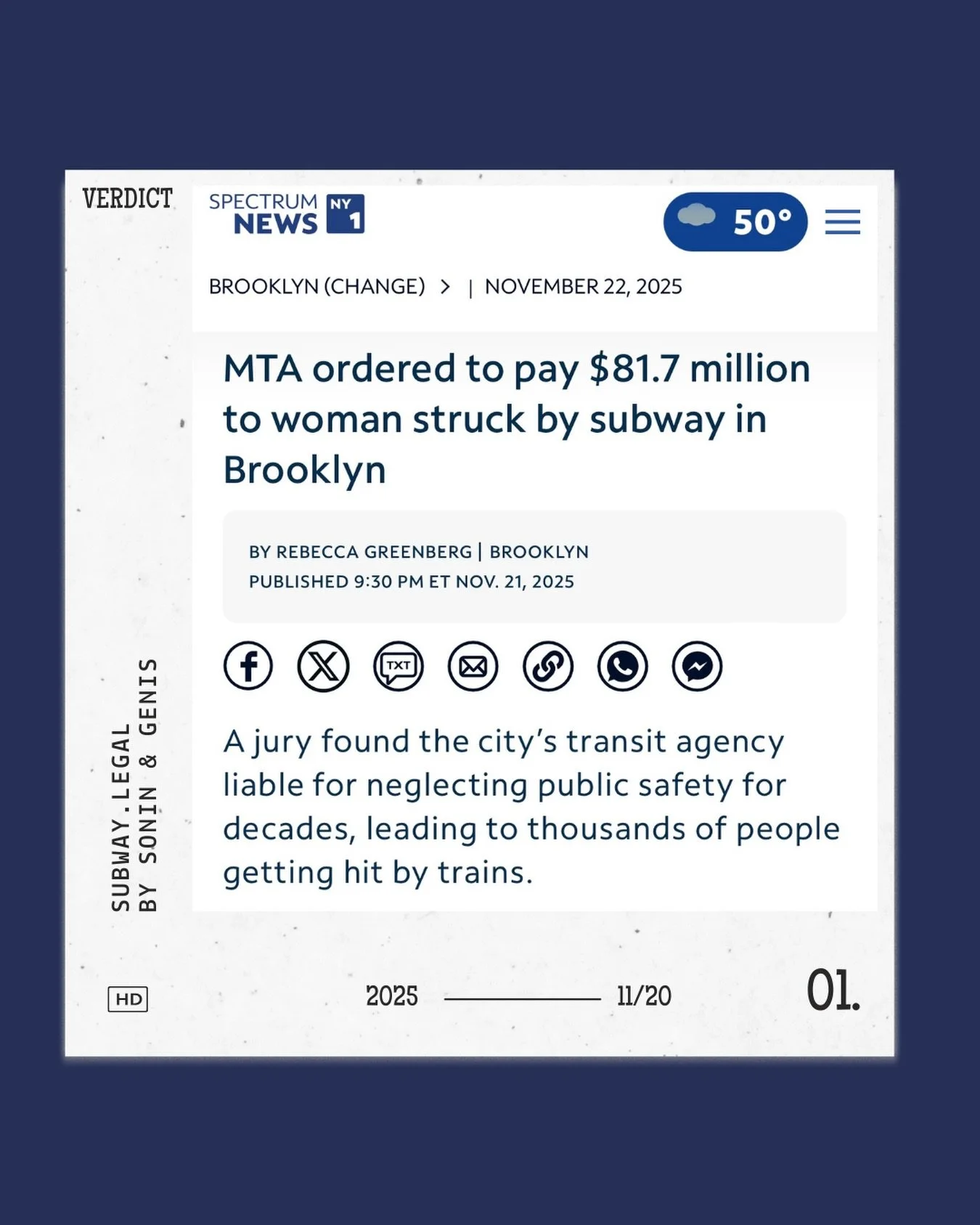
That year, they began working together on subway strike cases, combining their experience into a practice built to take the Transit Authority to trial. The results have been significant: multiple summary judgment defeats and, in November 2025, an $81.7 million jury verdict, the first in the United States to hold a transit authority liable for failing to install platform edge barriers.
The Transit Authority has known about the dangers of its open-platform system for decades. People fall onto the tracks. They are pushed. They come into contact with moving trains. None of this is unforeseeable, and safety measures that could prevent it have existed for more than thirty years. The two firms joined together to hold the Transit Authority accountable for that failure, and to make sure injured New Yorkers have someone in their corner when they do.
Featured Verdict
Jury Verdict
$81.7 Million
Harger Da Silva v. New York City Transit Authority, No. 1:17-cv-04550 (E.D.N.Y. 2025)
In August 2016, Luisa Janssen Harger Da Silva, a 21-year-old architecture student visiting from Brazil, fainted on the subway platform at the Atlantic Avenue–Barclays Center station in Brooklyn and fell to the tracks, where she was struck by an arriving train and suffered catastrophic injuries, including the loss of her left arm and left leg.
At trial, the team established that the MTA possessed fifteen years of data confirming that people would fall onto the tracks without platform barriers, and that the authority had declined a no-cost industry proposal — submitted by Faiveley Transport and described by the MTA itself as "impressive" — to install platform screen doors system-wide. The jury's verdict was the first in the United States holding a transit authority liable for failing to install platform edge barriers. Counsel for the plaintiff included David Roth and Elliot Shields of Roth & Roth, LLP, and Robert Genis of Sonin & Genis, LLC.
"The failure to act in the face of a known, preventable hazard is the definition of negligence."David Roth — Roth & Roth, LLP
"In the world of transportation, there are very few things that are almost 100% effective, and platform screen doors and these barriers are almost 100% effective."David Roth — Roth & Roth, LLP
"The common denominator and root cause is open access to the track. Get rid of open access to the track, and you get rid of the problem. It doesn't happen."Robert Genis — Sonin & Genis, LLC
Prior results do not guarantee a similar outcome.
The verdict — November 2025
Why Train Strike Cases Are Different
Locomotive event recorders overwrite. Forward-facing cameras get purged on cycles measured in days. Track geometry cars run their routes and the data moves on. Crew statements get taken — and shaped — long before any plaintiff has counsel. The difference between a viable case and a closed file is often decided in the first weeks after the incident, by the lawyer who knows what to demand and from whom.
Our two firms work these cases together because they reward the combination: deep trial experience on one side, dedicated railroad and catastrophic-injury practice on the other. We do not staff them out. We try them.
What the Work Requires
A train strike file is built from sources the public never sees and the defense rarely volunteers. Below are the categories of proof we develop in every case.
Locomotive event recorder downloads, dispatcher logs, radio audio, signal indications, train sheets, and time-distance reconstructions.
Engineer and conductor certifications, fatigue and hours-of-service review, sight-distance and perception-reaction analysis under the actual lighting and weather conditions.
Track inspection records, crossing geometry, warning device timing, vegetation and sight-line obstructions, platform gap and edge conditions for transit cases.
Federal Railroad Administration reportables, applicable operating rules, bulletins and special instructions, and the railroad's own training and compliance record.
Identifying which claims survive federal preemption analysis and structuring the pleadings and proof accordingly from day one.
Catastrophic injury life-care planning, vocational and economic loss analysis, and the medical narrative that connects mechanism of injury to long-term need.
Cases We Handle
Mainline and yard incidents involving pedestrians on or near the right-of-way, including sight-distance, audible warning, and speed issues.
Active and passive crossings, warning device adequacy and timing, sight-triangle obstructions, and pavement marking conditions.
Gap-and-fall, edge-of-platform strikes, crowd surge events, and station design and maintenance defects in subway and commuter rail systems.
MTA New York City Transit and other transit-system incidents involving unique notice-of-claim, statutory, and operational issues.
Cases involving regional commuter carriers and intercity passenger rail, each with its own regulatory framework and document custodians.
Class I and short-line freight strikes, including crew rule violations and yard and industrial-track incidents.
Selected Results
The verdicts and decisions below represent the firm's work in transit and railroad litigation. Each citation has been verified against the official reporter or court record.
Harger Da Silva v. New York City Transit Authority
Senior District Judge Frederic Block denied the Transit Authority's motion for summary judgment on three of four counts, holding that the TA acted in a proprietary rather than governmental capacity — defeating government function immunity as a matter of law — and that genuine disputes of material fact precluded summary judgment on qualified immunity and on the negligence claims relating to train operation, platform barriers, and track intrusion devices.
Judge Block certified the defendants' interlocutory appeal as frivolous, holding that New York state law immunity defenses confer only immunity from liability — not immunity from suit — and therefore fall outside the collateral order doctrine. The court retained jurisdiction and ordered the case to proceed to trial.
Federal jury verdict of approximately $81.7 million for a passenger who fainted on the Atlantic Avenue–Barclays Center platform, fell to the tracks, and suffered catastrophic limb loss. The verdict was the first in the United States holding a transit authority liable for failing to install platform edge barriers or screen doors.
Ortega v. New York City Transit Authority
Second Department affirmed leave to amend the complaint to add a negligent-design theory based on the Transit Authority's failure to install platform edge barriers or screen doors, holding that the timely notice of claim gave the Transit Authority notice of the design theory and that the relation-back doctrine applied.
Justice Lawrence Knipel, on reargument, directed defendants to answer each subsection of item 7(a-g) of plaintiff's bill of particulars regarding their qualified immunity affirmative defense — rather than responding with a single consolidated paragraph — and to produce documents responsive to plaintiff's discovery demands for the years 2014, 2015, and 2016. The order was subsequently affirmed by the Second Department in 2025.
Second Department affirmed an order compelling the Transit Authority to produce outstanding discovery related to its qualified immunity defense, issued upon reargument.
First Department held that discovery of prior similar subway door-closing incidents could not be confined to the specific door and platform at issue; information about prior incidents anywhere in the system was material to the question of the Transit Authority's notice of a dangerous condition.
Pollack v. New York City Transit Authority
Supreme Court compelled system-wide gap-accident discovery under penalty of preclusion and separately precluded the Transit Authority from asserting a qualified immunity defense it had never pleaded in nearly seven years of litigation.
First Department decided companion platform-gap appeals addressing the scope of system-wide gap-accident discovery.
Chacon v. New York City Transit Authority
Justice Joseph Risi granted reargument and amended a prior discovery ruling, directing the Transit Authority to produce all photographs and videos of the gap at the 82nd Street Station's 7 line for the three years preceding plaintiff's September 2015 fall, and — critically — all gap-related studies, reports, accidents, and injuries system-wide across the entire New York City Subway System for the same period. The court further ordered that if any such records no longer exist, the Transit Authority must provide an affidavit from a person with personal knowledge explaining whether the documents ever existed, how they were disposed of or deleted, and why they no longer exist. The Second Department affirmed in 2024.
Second Department addressed the scope of system-wide gap-related discovery in a platform-gap case involving a fall at the 82nd Street station in Queens in September 2015.
Justice Mitchell J. Danziger so-ordered a stipulation compelling the Transit Authority to respond within thirty days to specific numbered demands — including requests for prior similar incident records, maintenance and inspection logs, and gap-related data — from plaintiff's demand set dated May 25, 2021, to provide a Bill of Particulars of its Affirmative Defenses, and to produce its witness for an examination before trial no later than June 26, 2024. The Transit Authority's agreement to the stipulated terms, before the same judge who handled Scalice and against the backdrop of prior discovery orders across multiple platform-gap cases, reflected the accumulated weight of precedent Roth & Roth, LLP had built in this practice area.
Justice Mitchell J. Danziger granted plaintiff's motion to compel in part, directing the Transit Authority to produce records of prior similar gap incidents for three years preceding plaintiff's December 2019 fall at the Parkchester East 177th Street Station in the Bronx, to produce maintenance and inspection records for the platform and northbound 6 train line, to identify eyewitnesses, and to provide specific — rather than boilerplate — objections to outstanding discovery demands.
Prior results do not guarantee a similar outcome.
The Trial Team
David A. Roth is a founding partner of Roth & Roth, LLP, a trial attorney admitted to practice before the Supreme Court of the United States who has represented thousands of seriously injured plaintiffs in state, appellate, and federal courts since 1991, with a particular focus on municipal transit liability and catastrophic injury. A longtime officer and past Treasurer of the New York State Trial Lawyers Association, chair of its Municipal Liability Committee, and a perennial Super Lawyers honoree, he is regularly sought as co-counsel on complex transit and municipal design cases across the country.
Robert Genis is the Senior Founding Partner of Sonin & Genis, LLC, a trial attorney with decades of experience obtaining multi-million dollar verdicts and settlements for families of those killed or seriously injured in negligence, medical malpractice, and products liability cases in New York, New Jersey, and Connecticut. A Lifetime Member of the Million Dollar Advocates Forum, Super Lawyer, and National Trial Lawyers Top 100 inductee, he is the recipient of the Bronx County Bar Association's "Lawyer's Lawyer" award.
Audra R. Roth is a founding and managing partner of Roth & Roth, LLP, admitted to practice since 1994 with experience on both the plaintiff and defense sides of personal injury litigation before co-founding the firm with David A. Roth in 1998. She has successfully litigated thousands of cases spanning transit accidents, municipal liability, premises liability, and wrongful death, and holds Supreme Court and Appellate Court victories before New York courts, with active membership in the New York State Trial Lawyers Association, New York State Academy of Trial Lawyers, the American Bar Association, and the Brooklyn Women's Bar Association.
Elliot Shields is an attorney at Roth & Roth, LLP, admitted to practice since 2012 following graduation magna cum laude from New York Law School. He has represented hundreds of clients in personal injury and civil rights matters across New York state and federal courts, recovering millions for injured plaintiffs, including a $5,632,962 jury verdict in a personal injury trial and a $750,000 wrongful death verdict. He has won precedential appellate decisions on transit-system discovery and is a member of the New York State Trial Lawyers Association and the New York City Bar Association.
Thomas W. Reimel is an attorney at Roth & Roth, LLP, admitted in New York and Pennsylvania, and a cum laude graduate of Western Michigan University Law School (2005). He began his career as a public defender before serving as in-house trial and appellate brief writer for a personal injury and admiralty firm in Philadelphia, where he litigated matters ranging from products liability to a case of first impression under Pennsylvania's Equine Activities Act. Since relocating to New York, his practice has focused on transportation, automobile, and premises liability litigation.
Max Silverberg is an attorney at Sonin & Genis, LLC who represents victims of catastrophic injuries and their families throughout New York. He has extensive experience in complex personal injury litigation, including cases against municipal entities, and has helped secure significant recoveries for injured clients across the Bronx, Brooklyn, Manhattan, and Queens. He has been recognized as a Super Lawyers Rising Star and by TopVerdict for his results in personal injury litigation, and is a member of the New York State Trial Lawyers Association and the New York County Lawyers Association.
For Families
Families reach us at every stage — sometimes within hours of an incident, and sometimes long after the funeral, when something in the official account stopped making sense. There is no wrong moment to call. But the sooner an attorney is involved, the more of the railroad's contemporaneous record can be preserved by formal demand rather than reconstructed later from secondary sources.
Important. Claims involving public transit authorities and certain other entities are subject to short statutory notice periods that can be measured in days, not years. Whether any particular deadline applies to a specific incident depends on the parties and facts involved, and should be evaluated by counsel as soon as possible.
Initial consultations are confidential and without charge. We accept these cases on a contingency basis. There is no fee unless we recover.
Contact
Either firm can take an initial call. Inquiries are routed to a senior attorney.